
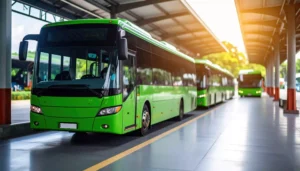
The way that traveling passengers and ground crews travel through airport terminals is changing at the same lightning speed as the aviation industry’s transition to a more modern and greener future. Since the beginning, DINOBUS has been pushing this shift by creating dependable, emission-free electric apron buses that redefine operational effectiveness and environmental responsibility. With the goal to transform airport mobility for the generation that follows, we are steadily getting organized to make the next significant step: incorporating autonomous driving technology into our electric bus systems.
The Overall Vision
Airports are complex systems that follow exact schedules and prioritize efficiency and safety above all else. To keep everything running smoothly, ground transportation is essential, especially the apron buses that transport passengers between terminals and airplanes. However, there are disadvantages to traditional operations, such as the need for constant communication between drivers, ground controllers, and flight coordinators, unpredictable traffic conditions, and high labor demands.
DINOBUS wants to offer a more intelligent solution that lowers carbon emissions, minimizes human error, strengthens route management, and upholds the highest safety standards by coupling autonomous navigation with our tried-and-true electric bus technology.
Building the Foundation for Autonomy
In addition to increasing energy efficiency and timeliness, we’d like to make the airside environment safer, quieter, and cleaner. A number of crucial systems need to function together before completely autonomous apron buses can hit the tarmac. Both passengers and airports could possibly gain real advantages from the incorporation of autonomy into aspects of transportation.
Operational Efficiency: Autonomous buses can work with extreme precision, cutting down on idle time and turnaround times. In order to guarantee that buses are always in the right place at the right time, routes and schedules can be automatically optimized based on aircraft arrival and departure data.
Safety Improvement: One of the main hazards in airside operations is human error. DINOBUS can keep a safer distance and react quickly to abrupt changes on the apron thanks to AI-assisted driving, obstacle detection, and automated braking systems.
Environmental Responsibility: All DINOBUS vehicle models are completely electric and emit no tailpipe emissions. Autonomous technology will also reduce overall energy consumption and airport emissions when paired with energy-efficient driving patterns and optimized routing.
Passenger Experience: Autonomous systems will bring about smoother, quieter rides and more consistent service intervals, helping passengers to enjoy an effortless transfer between aircraft and terminal.
Upcoming Challenges
The reason why we’re going slow and steady with this future goal is the well-known and common challenges facing autonomous vehicles in the transport sector. Technology, infrastructure, and regulations are some of these roadblocks that autonomous buses have to overcome to grow popular. One significant challenge is maintaining safe and dependable navigation in intricate, busy airport settings where buses must coexist with service vehicles, pedestrians, and airplanes in a variety of weather and lighting scenarios. In order to manage these changing situations and preserve passenger comfort and timeliness, the integration of sensors, cameras, and artificial intelligence must be strong enough. Furthermore, the high operational demands of continuous shuttle service must be balanced with the limited battery range of electric power systems, necessitating effective scheduling and charging infrastructure. While public trust and acceptance of autonomous transportation remain crucial for widespread adoption, deployment is further complicated by regulatory approval, cybersecurity, and interoperability with current airport management systems.